Rockwill’s Arc Quenching Technology for MV/HV Circuit Breakers: From Classical Interruption to Intelligent Coordination
Rockwill's arc quenching technology system is essentially a microcosm of the power switchgear field's response to the dual challenges of "higher interrupting performance" and "zero environmental impact across the entire lifecycle." Its complete landscape consists of three parts: high-performance hardware arc quenching platforms, stringent standard certification systems, and future-oriented intelligent switching control strategies. This constitutes a capability leap from "being able to interrupt" to "interrupting intelligently." The system primarily encompasses three major hardware arc quenching technology routes, and empowered by standards and intelligent technologies, it clearly demonstrates a strategic evolution path from "high arc energy handling" towards "fluorine-free low emission," and then towards "synchronized active management via point-on-wave control."
I. SF6 Arc Quenching Technology: Deep Integration of Self-Blast and Puffer
Rockwill's SF6 circuit breakers do not rely on a single arc quenching principle. Instead, targeting the fundamentally different interruption physics of high and low currents, they creatively integrate "self-blast" and "puffer" technologies to achieve excellent interrupting performance across the entire current range. Representative products cover the HD4, HM4, RHB, RHD, LW series, among others, with interrupting capabilities reaching 40-63 kA.
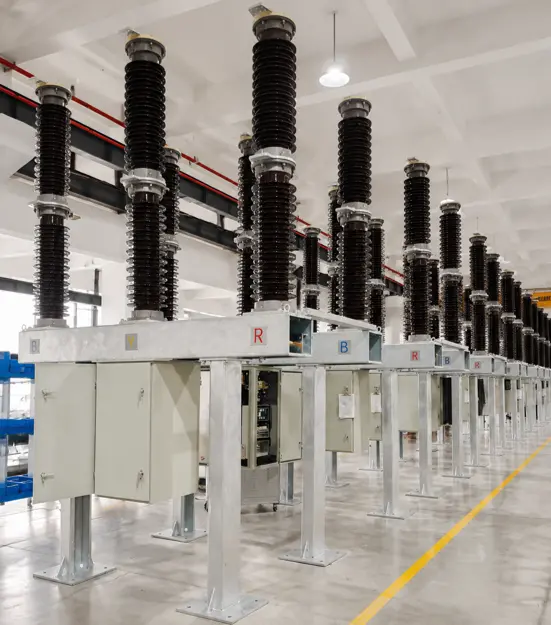
Physical Photograph of RHB Series 72.5kV Live Tank SF6 Gas Circuit Breaker
During high-current interruption, the self-blast principle dominates. The arc itself is an extremely high-energy heat source. The self-blast chamber uses this arc energy to heat the SF6 gas, rapidly building high pressure in an expansion volume. At current zero, this creates a powerful gas blast. The greater the arc energy, the stronger the gas blast pressure – an adaptive mechanism that "uses the opponent's strength against them," minimizing the burden on the operating mechanism. Products achieving 63 kA-level interruption demonstrate that their expansion chamber configuration and gas path design can efficiently convert arc thermal energy, channeling the hot gas in an orderly manner to prevent thermal breakdown.
During low-current interruption, the puffer principle plays a key role. The difficulty in interrupting low inductive and capacitive currents lies not in immense energy, but in the dangerous overvoltages and restrikes that can be caused by current chopping. Here, arc energy is insufficient to establish an effective self-blast. Therefore, it relies on the operating mechanism to mechanically compress SF6 gas, providing an initial, controlled arc-extinguishing gas flow. This ensures rapid and stable dielectric recovery precisely at current zero. While increasing the mechanism's reaction force, this method ensures a "smooth" and precisely controllable low-current interruption, effectively avoiding current chopping and restrike.
This hybrid technology enables a single interrupting chamber to maintain excellent performance across different fault current levels and facilitates platform-based sharing of interruption units for primary distribution equipment like HD4/HM4, ring main units like RHB/RHD, and LW outdoor pole-mounted switches.
II. Vacuum Arc Quenching Technology: High Speed, Cleanliness, and Long Electrical Life
Vacuum arc quenching is the core pillar of Rockwill's fluorine-free strategy. It leverages the extremely high dielectric strength of near-vacuum (≤10⁻⁴ Pa) to extinguish the arc at natural current zero. Representative products include the RVB, RVD, RMR series, with interrupting capabilities covering 25-50 kA.
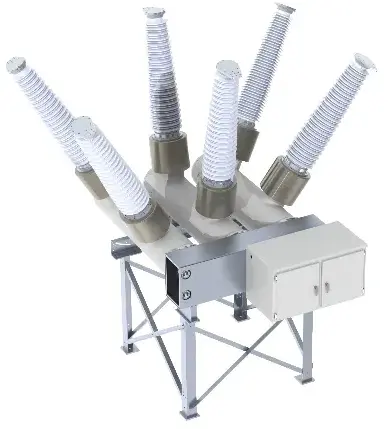
Physical Photograph of RVD Series 145 kV SF6-free Dead Tank Circuit Breaker
Its core advantages are prominent: very fast breaking speed (typically <10 ms), contact electrical life exceeding 10,000 operations, and zero greenhouse gas emissions. However, to reliably achieve these indicators at the 50 kA level, several technical peaks must be overcome:
- High-Current Anode Spot Control: A 50 kA arc generates intense anode spots on the contact surface, causing significant metal vapor evaporation and compromising vacuum insulation. Rockwill must have deeply optimized the micro-proportions of CuCr contact materials and the control of axial/transverse magnetic fields to diffuse the arc uniformly and prevent localized overheating and welding.
- Achieving Very Short Arcing Time: Breaking speeds under 10 ms rely on a high-response operating mechanism and rapid contact separation to minimize the time needed to establish a sufficient insulation gap and reduce arc energy injection. However, this imposes higher demands on mechanism impact and mechanical life management.
- Current Chopping and Overvoltage Suppression: An inherent drawback of vacuum arc quenching is current chopping – the current being forcibly interrupted before its natural zero point. This can generate dangerous overvoltages, especially when interrupting low inductive currents. This is an intrinsic characteristic of vacuum technology, requiring the development of low-chopping current contact materials and mitigation via system insulation coordination.
III. SF6-free Green Arc Quenching Matrix: Technical Trade-offs of Multiple Routes
Beyond SF6 and vacuum technologies, Rockwill actively builds a fluorine-free environmentally friendly technology matrix. This is not simply a stack of options, but reflects the profound technical trade-offs in the "de-SF6" process for medium- and high-voltage equipment. The matrix comprises three paths, carried by series like RVD, with interrupting capabilities also covering 25-50 kA.
Path 1: "Vacuum interrupter + Clean air insulation." This solution has the highest technical maturity, with extensive application at 12-40.5 kV. Its environmental advantage is outstanding: clean air has zero Global Warming Potential (GWP), is completely non-toxic, and end-of-life disposal is simple, requiring no gas recovery or treatment. However, the engineering trade-off is significant: due to air's much lower dielectric strength compared to SF6, larger insulation distances are required, leading to substantially larger equipment dimensions, making direct replacement within existing SF6 switchgear footprints challenging.
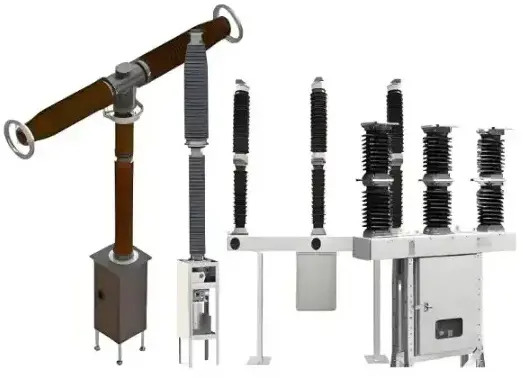
Physical Photograph of RVB Series SF6-free Live Tank Vacuum Circuit Breaker
Path 2: "Vacuum interrupter + Eco-friendly gas insulation," e.g., using g3/N2 gas mixtures. This path has medium technical maturity. Its core advantage is that the eco-friendly gas (near-zero GWP) provides dielectric performance close to SF6, thus maintaining compact equipment dimensions, serving as a direct substitute for SF6 switchgear. The challenges lie in the long-term chemical stability of the alternative gas, its decomposition products under arcing or partial discharge, and the compatibility of these products with internal materials – all requiring long-term operational validation. Maintenance procedures must be re-established, and current equipment costs are relatively high.
Path 3: "Pure vacuum insulation (solid insulation)." This is a frontier technology, with the concept of completely eliminating gaseous media: vacuum handles interruption, solid materials handle insulation support. Its environmental advantage is ultimate, with no gaseous media whatsoever, theoretically enabling truly maintenance-free operation. However, engineering challenges are greatest: aging of solid insulation under long-term high electric fields, partial discharge characteristics, and heat dissipation are all technical difficulties, demanding extremely high cleanliness and precision in manufacturing processes.
The engineering selection logic thus becomes very clear: For applications pursuing ultimate zero emissions with ample installation space, the clean air solution is ideal. For direct SF6 replacement within existing building or switchgear dimensions, eco-friendly gases like g3 offer better compatibility. For scenarios with ultimate maintenance-free demands and acceptable frontier technology risks, pure vacuum solid insulation can be attempted. This matrix ensures Rockwill can provide a corresponding mature product under any regulatory policy. The RVD series, likely combining a "vacuum interrupter with eco-friendly external insulation medium," is the core vehicle for this fluorine-free design.
IV. Standard System: Performance Yardstick and Market Passport
Parameters marked on Rockwill products, such as 40-63 kA, 25-50 kA, must be verified through a series of rigorous type tests according to international standards. Standards define technical baselines and deeply drive the evolution of technical routes.
Core interrupting performance standards (IEC 62271-100 / GB 1984) are fundamental constraints. Short-circuit test sequences require the breaker to successfully interrupt under demanding conditions like full-rated symmetrical, asymmetrical (including DC component), short-line fault, and out-of-phase switching. Self-blast SF6 chambers must prove their gas blast does not lead to thermal restrike under any transient condition. For vacuum interrupters, 10,000 operations correspond to E2 class electrical endurance, while M2 class mechanical endurance requires 10,000 operations without failure.
Eco-friendly medium qualification standards (IEC 62271-204, and new standards for fluorinated-free gases) directly provide the benchmark for the green matrix. Switchgear using g3/N2 or clean air must undergo qualification for insulation, temperature rise, and long-term material compatibility. Regulations like the EU F-gas Regulation (EU) 2024/573 mandate using media with a GWP of no more than 1 for new medium-voltage primary distribution equipment after 2026, creating mandatory market space for Rockwill's vacuum + clean air solution.
Specific standards for vacuum interrupters strictly limit implicit details like chopping current value and X-ray radiation, ensuring the safe usability of vacuum technology. Standards related to intelligent functions (IEC 61850, IEC 62271-108 Controlled switching) provide communication and control compliance frameworks for subsequent intelligent switching and synchronous arc quenching technologies.
V. Future-Oriented Intelligent Switching and Synchronous Arc Quenching (Controlled Switching)
If the interrupting chamber is the "muscle," then intelligent control is the "nervous system and brain." To fully adapt to high-penetration renewable energy integration and complex transient grids, Rockwill's hardware arc quenching platforms inevitably evolve towards intelligent switching and synchronous arc quenching.
1. Intelligent Switching: From Passive Interruption to Active Management
Intelligent switching equips the circuit breaker with a closed-loop "sensing-decision-execution" capability. It involves real-time current waveform acquisition, adaptive determination of the switching nature (inductive/capacitive/short-circuit), and dynamic adjustment of the operating mechanism's motion curve. For example, when switching capacitor banks, it can actively reduce opening speed near voltage zero, allowing the arc to extinguish smoothly at the natural current zero, thereby eliminating restrikes. Simultaneously, online monitoring of vacuum level, gas density, decomposition products, etc., enables accurate life prediction, transforming the 10,000-operation life of vacuum interrupters into truly data-driven maintenance-free operation.
2. Synchronous Arc Quenching (Controlled Switching): A Multiplier for Hardware Capability
Controlled switching means precisely controlling the phase angle at which contacts separate, allowing the arc to extinguish at a pre-optimized moment. This yields significant benefits for each technology route:
- For vacuum interrupters: It ensures contact separation within a predetermined short arcing time window before current zero. This provides sufficient contact gap to withstand transient recovery voltage while avoiding high-amplitude chopping overvoltages from premature extinction, enabling large-capacity vacuum interrupters to be safely applied to severe loads like reactors and capacitor banks.
- For SF6 self-blast interrupters: It stabilizes the arcing time within an optimal range, maximizing the blast pressure from the self-blast expansion volume. This enhances 63 kA-level interruption reliability and reduces the energy demand on the operating mechanism.
- For eco-friendly gas hybrid solutions: Controlled switching reduces energy fluctuation during interruption, lessening the extreme stress on the eco-friendly gas's arc quenching capability, allowing "vacuum interrupter + eco-friendly gas insulation" solutions to achieve interrupting performance equivalent to pure SF6 equipment.
3. Rockwill's Potential Intelligent Integration
A foreseeable layered architecture includes a base layer of high-performance interrupting chambers and reliable mechanisms, a control layer integrating point-on-wave algorithms and IEC 61850 communication, and a sensing layer with multi-physical sensors. In scenarios like renewable energy grid connection and offshore wind power, intelligent circuit breakers can actively suppress inrush currents, reduce switching overvoltages, extend interrupter life by 2-3 times, and achieve a leap from device to "intelligent switching solution."
VI. Conclusion: 3 Hardware Pillars + 2 Enablers – Building Future Competitiveness
Rockwill's integrated arc quenching technology system can be summarized as a "3 Horizontal Pillars + 2 Vertical Enablers" architecture.
- 3 Horizontal Pillars: SF6 self-blast + puffer arc quenching, high-speed vacuum arc quenching, and fluorine-free eco-friendly arc quenching. These constitute hardware technology platforms covering all scenarios, addressing high arc energy handling, high-speed long-life requirements, and zero-carbon emission needs respectively.
- 2 Vertical Enablers: A stringent international standard system ensures the performance baseline and environmental compliance for each technology. Intelligent switching and synchronous arc quenching technologies act as control strategies, elevating hardware capability from "being able to interrupt" to "interrupting intelligently," enabling real-time coordination of the arc quenching process with the dynamic demands of modern power systems.
This deep technology integration allows Rockwill to simultaneously occupy the three tracks of mature SF6 solutions, mainstream vacuum technology, and eco-friendly alternatives, while achieving capability elevation through intelligent control. Regardless of future regulatory tightening or increasing power system complexity, this strategic layout ensures Rockwill can provide complete solutions – from equipment to lifecycle management, from hardware to intelligent coordination – securing a favorable industry position.
Deployed Equipment
-
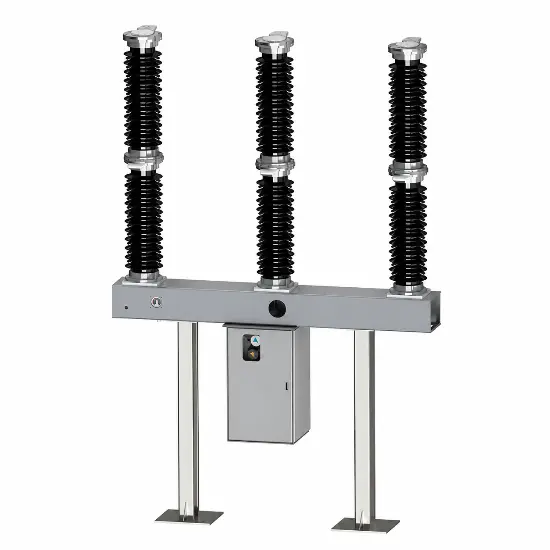 Outdoor Live tank SF6 gas circuit breaker 72.5kVAdopting self-blast arc extinguishing principle and three-phase post porcelain insulator structure, the breaker is equipped with a CT-type spring operating mechanism with three-pole linked operation. It uses SF₆ gas for full-phase insulation and arc quenching, fitted with pointer-type density relay for real-time SF₆ pressure and density monitoring.Simple structure, low operating power, low noise, high stability and easy installation. Compliant with IEC / CEI / GB / JB / DL standards, and support
 -
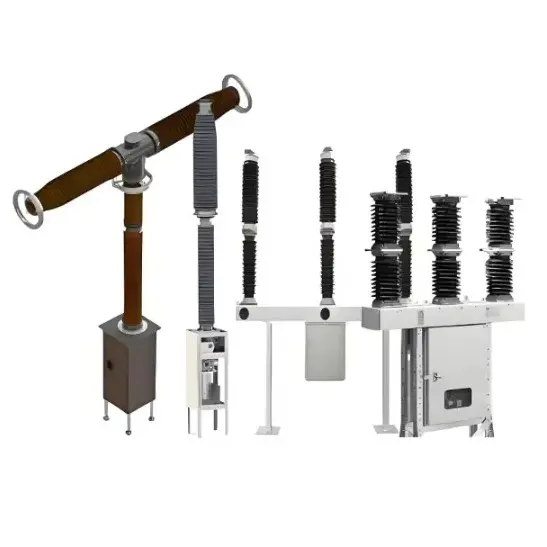 Low‑maintenance live tank vacuum circuit breaker-24kV to 145kVDescription:The 24kV - 145kV Live tank Vacuum circuit breakers are advanced high - voltage electrical devices. Using vacuum as the arc - extinguishing and insulating medium, they leverage vacuum's superior insulation and rapid arc - quenching capabilities to instantly interrupt fault currents, preventing arc re - ignition and ensuring grid stability. The live tank design encapsulates the vacuum interrupters within a metal tank filled with insulating gas, enhancing insulation, mechanical robustne
 -
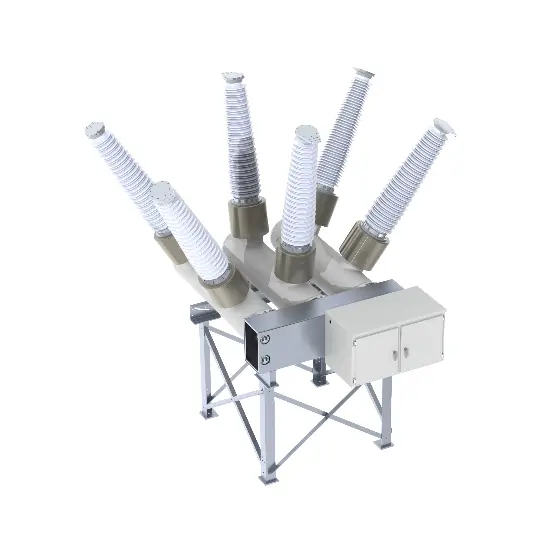 High reliability SF6-free Dead Tank Circuit Breaker-145 kVProduct OverviewBased on this expertise, we have developed a SF6-free dead tank circuit breaker (DTCB) that is very similar to its SF6 predecessor. Using our g3 insulating and switching SF6-free technology, the new RVD-145 remains compact with the same footprint. Performance and life-cycle costs remain similar while offering a significant decrease in carbon footprint. The SF6-free gas mixture used in the new RVD-145 works on the same well-known principle for insulation and breaking purposes as t