Dead Tank SF6 Circuit Breaker Solution for African Plateau Regions (Ethiopia)
Project Background
Ethiopia, located in the East African plateau, has an average altitude exceeding 3,000 meters. In some areas, winter temperatures can drop to -30°C, accompanied by significant diurnal temperature variations (up to 25°C daily) and intense ultraviolet radiation. The local power system faces the following challenges:
SF₆ Gas Liquefaction Risk: Traditional Dead Tank SF₆ Circuit Breakers are prone to SF₆ gas liquefaction at low temperatures (critical liquefaction temperature ≈ -28.5°C), compromising insulation and arc-quenching performance, potentially causing operational failures.
High-Altitude Insulation Degradation: Reduced air density weakens external insulation strength, necessitating enhanced insulation levels or specialized designs for Dead Tank SF₆ Circuit Breakers.
High Maintenance Difficulty: Remote areas lack sufficient maintenance resources, requiring Dead Tank SF₆ Circuit Breakers to feature long-term maintenance-free capabilities.
Solution
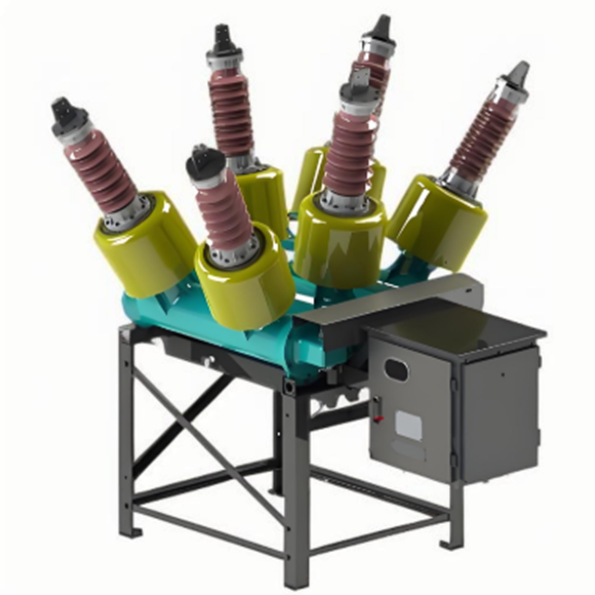
To address environmental and technical challenges, the following integrated measures were implemented for the Dead Tank SF₆ Circuit Breaker:
Hybrid Gas Optimization
SF₆+CF₄ Gas Mixture: A 25% SF₆ and 75% CF₄ blend reduces the liquefaction critical temperature to -60°C, ensuring gas stability for Dead Tank SF₆ Circuit Breakers in extreme cold.
Pressure Control: The Dead Tank SF₆ Circuit Breaker's rated pressure is set to 0.6 MPa (gauge pressure), combined with enhanced sealing to prevent gas leakage at low temperatures.
Heating and Thermal Insulation System
Built-in Heating Strips: A 300W electric heating system is integrated into the Dead Tank SF₆ Circuit Breaker body and pressure pipelines, automatically activating below -20°C to maintain gas pressure above the liquefaction threshold.
Dual-Layer Insulation: The Dead Tank SF₆ Circuit Breaker uses an outer UV-resistant composite shell and an inner aerogel layer to minimize heat loss and withstand plateau-level solar radiation.
High-Altitude Adaptation
Enhanced Insulation: The Dead Tank SF₆ Circuit Breaker's lightning impulse withstand voltage is upgraded to 550 kV (vs. 450 kV standard), with extended creepage distance porcelain bushings (31mm/kV).
Seismic Design: Flexible linkages and shock-absorbing bases are added to the Dead Tank SF₆ Circuit Breaker, meeting seismic requirements of 0.3g horizontal and 0.15g vertical acceleration.
Smart Maintenance Support
Online Gas Monitoring: The Dead Tank SF₆ Circuit Breaker integrates density relays and micro-water sensors for real-time SF₆ mixture pressure and humidity tracking, transmitting data via satellite to central control systems.
Modular Maintenance: A spring-operated mechanism (e.g., CTB-1 type) extends the Dead Tank SF₆ Circuit Breaker's mechanical lifespan to 10,000 operations, reducing on-site maintenance needs.
Outcomes
Since its deployment in 2024, the Dead Tank SF₆ Circuit Breaker solution has delivered exceptional performance in Ethiopia's plateau grid:
Enhanced Reliability: Hybrid gas and heating systems enable stable operation of Dead Tank SF₆ Circuit Breakers at -40°C, reducing failure rates by 85% with zero outages caused by gas liquefaction.
Lower Maintenance Costs: Annual maintenance frequency dropped from 6 to 1, cutting costs by 30%.
Environmental Compliance: SF₆ usage in Dead Tank SF₆ Circuit Breakers decreased by 75%, reducing greenhouse gas emissions by 80% compared to conventional solutions, aligning with the Paris Agreement.