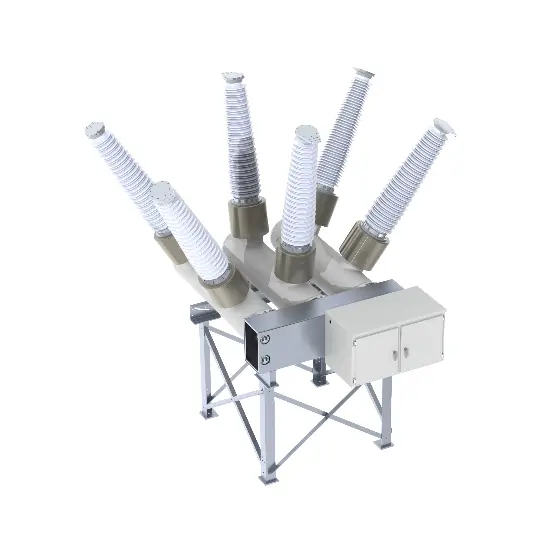
Dead Tank Vacuum Circuit Breaker(VCB)-36kV / 72.5kV
Key attributes
| Brand | ROCKWILL |
| Model NO. | Dead Tank Vacuum Circuit Breaker(VCB)-36kV / 72.5kV |
| Rated voltage | 72.5kV |
| Rated normal current | 2000A |
| Rated frequency | 50/60Hz |
| Series | RVD |
Description
Product Description
Developed based on advanced core technologies and mature mass-production experience, the dry-air insulated dead-tank vacuum circuit breaker adopts vacuum interrupters for arc extinction and dry air as insulating medium. No decomposition of insulating gas occurs during current interruption, delivering high reliability and outstanding operational performance.
Product Features
Optimized for green procurement, this dead-tank VCB is designed under two core concepts: first, complying with eco-friendly design standards including the 3R principle (Reduce, Reuse, Recycle) and LS criteria (Long service life & Separable structure); second, cutting down the Life Cycle Cost (LCC) to balance economic efficiency and environmental protection.
Superior Interruption Performance:Equipped with vacuum interrupters for each breaking pole, the product features outstanding dielectric recovery capacity and achieves reliable performance under severe working conditions such as short-circuit interruption and short-line fault interruption.
Strong Resistance to Multiple Surges and Evolving Faults:Fitted with full self-arc-diffusion vacuum interrupters, the breaker can withstand multiple lightning surges and reliably interrupt evolving fault currents to accommodate complicated grid fault conditions.
Reduced Maintenance Workload:The vacuum-based breaking unit requires no routine inspection on core arc-extinguishing components, significantly saving maintenance man-hours and lowering long-term service costs.
Specifications
Rated voltage (kV) |
36 |
72.5 |
||
Rated frequency (Hz) |
50/60 |
|||
Rated normal current (A) |
2000 |
2000/3150 |
||
Lightning Impulse Withstand Voltage |
General Value (Phase-to-Earth / Phase-to-Phase |
170 kV |
325 kV |
|
Across Isolating Distance |
195 kV |
375 kV |
||
Power-Frequency Withstand Voltage |
General Value (Phase-to-Earth / Phase-to-Phase) |
70 kV |
140 kV |
|
Across Isolating Distance |
95 kV |
160 kV |
||
Rated short circuit breaker current (kA) |
31.5 |
40 |
||
Rated transient recovery voltage |
Rate of rise (kV/μs) |
1.19 |
1.47 |
|
First pole to clear factor |
1.5 |
|||
Rated short circuit making current (kA) |
82 |
104 |
||
Rated short time current (kA) |
31.5 (3s) |
40 (3s) |
||
Rated breaking time (cycle) |
3 |
|||
Rated opening time (s) |
0.033 |
0.03 |
||
Make time with no load (s) |
0.05 |
0.10 |
||
Operating duty |
O-0.3s-CO-15s-CO |
|||
Closing control voltage (Vdc) |
48, 100, 110, 125, 250 |
|||
Rated tripping voltage (Vdc) |
48, 100, 110, 125, 250 |
|||
Supply voltage for charging motor |
(Vdc) |
48, 100, 110, 125, 250 |
||
(Vac) |
60, 120, 240 |
|||
Rated dry-air pressure |
0.5MPa-g (at 20℃ ) |
|||
Closing operation system |
Spring |
|||
Tripping control system |
Spring |
|||
Applicable standard |
IEC 62271-100-2008, ANSI/IEEE C37.06-2009 |
|||
Construction
Overall construction
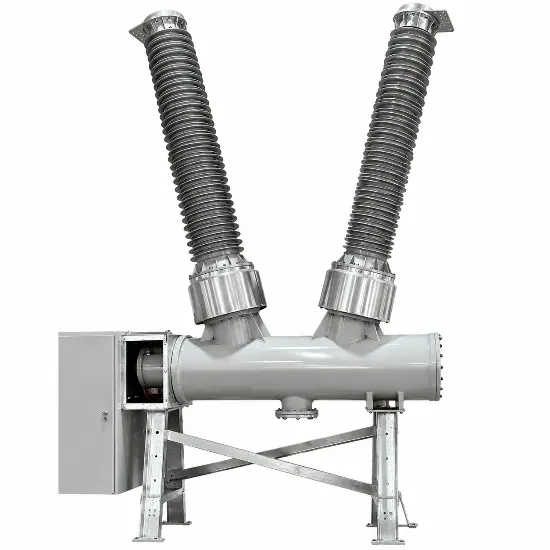
For each phase, a current breaking vacuum interrupter is accommodated in the grounded tank. The operation system is such that closing and tripping are effected by spring force.The operating mechanism and 3-phase interlinkage are assembled on a common base, which is installed on the frame legs.
Internal construction
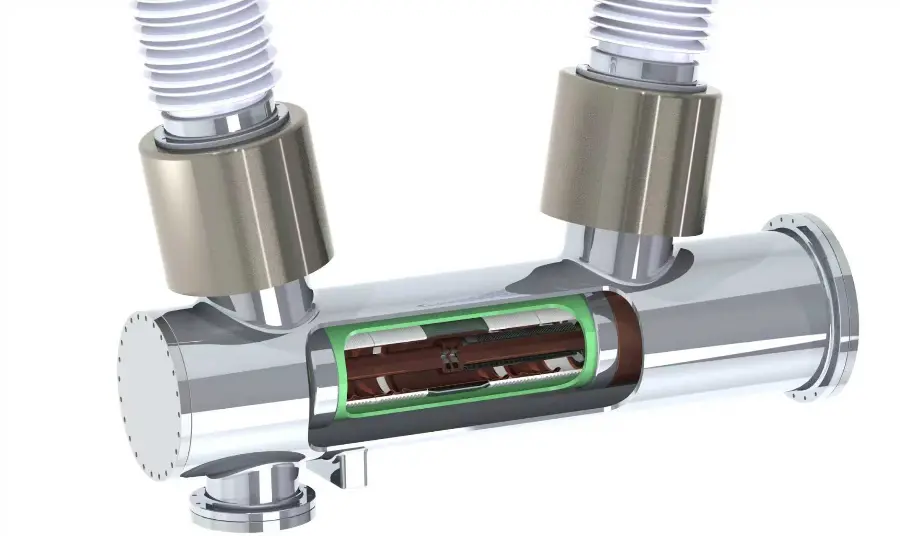
The overall structure is composed mainly of grounded tank, vacuum interrupters (VI), insulating rods, bushings and main circuit terminals. Each grounded tank is filled with dry air maintained at a rated pressure of 0.5MPa-g (20℃).
Internal construction of vacuum circuit breaker
Performance
Performance of the circuit breaker has been designed in accordance with ANSI and IEC standard, and verified by type test. All products are shipped after confirmation of various performances by acceptance test based on these standards.
Withstand voltage characteristics :Performance of withstand voltage is assured at the specified dry air pressure. Even though the dry air pressure has been lowered to the alarming level, the required insulation level can be assured.In addition, even though this pressure lowers to the atmosphericpressure, the circuit breaker withstands the rated voltage.
Current passing performance :Since the main contacts are located under vacuum, their surfaces are never oxidized and current passing performance is therefore stabilized. In the closing mode of circuit breaker, a pressing force is exerted between main contacts by the effect of pressing spring and sufficient tolerance is assured against closing current and short-time current.
Documentation Resource Library Dead Tank Circuit Breaker
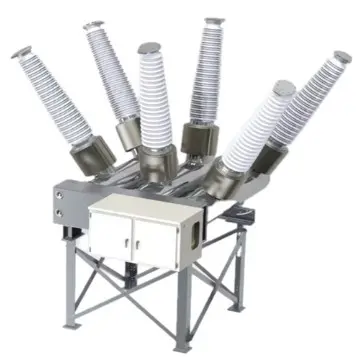
FAQ for Dead Tank Circuit Breaker
Rockwill’s SF6-free eco-friendly vacuum circuit breakers (rated up to 40.5kV) are built on a proprietary, fully independent R&D technical system, offering significant scalable and series-based advantages. Furthermore, backed by our rigorous digital manufacturing management system, we formally commit to and strictly fulfill a 10-year warranty requirement.
Rockwill is an open-minded, professional R&D and manufacturing enterprise. We fully accept ODM/OEM partnership orders from Europe, North America, and all other global regions.
Rockwill’s 60kV, 63kV, 66kV, and 72.5kV products belong to a series-based product line developed on a single technical platform. In contrast, the 88kV to 123kV and 145kV ranges belong to a separate technical platform series. Rockwill is currently dedicated to developing the next generation of smarter, longer-lifespan HV eco-friendly SF6-free switchgear; please feel free to contact us for further details.
Yes. Rockwill is continuously driving technological advancements in greener, more reliable, and smarter high-voltage switches. We will gradually extend our product portfolio to even higher voltage levels in the future.
The core difference is the arc-extinguishing medium. A VCB uses a high vacuum inside a sealed ceramic or glass envelope — the vacuum rapidly diffuses ions and metal vapor after current zero, achieving arc extinction in <10 ms. An SF₆ CB uses sulfur hexafluoride gas, which has strong electron affinity — it captures free electrons to form heavy negative ions, quickly depleting the arc channel's conductivity.
The interrupter is typically installed inside the tank, resulting in a highly compact overall structure that enables efficient arc quenching within a limited space. Depending on the arc extinguishing principle and technical approach, the specific configuration of the interrupter may vary, but all designs include core components such as moving/stationary contacts, a nozzle, and insulating parts. During opening operation to interrupt the current, these components work together to achieve fast and reliable extinction of the arc.
-
SF6 Free/Pure Air Dead tank vacuum circuit breaker 12kV-145kV
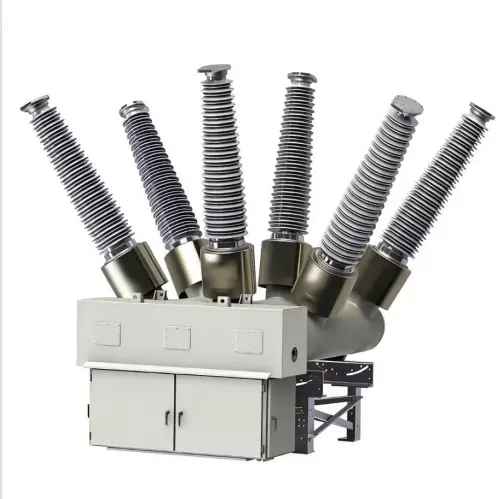
-
Customization Dead tank SF6 Gas Circuit-Breaker 362kV- 550kV
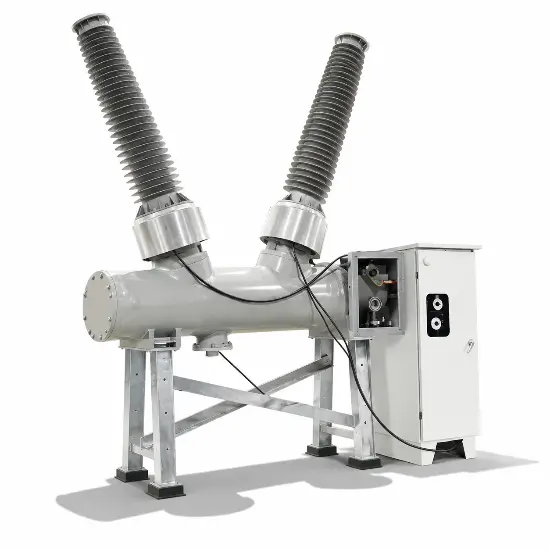
-
High-voltage AC Dead tank SF6 circuit breaker 145kV 170kV
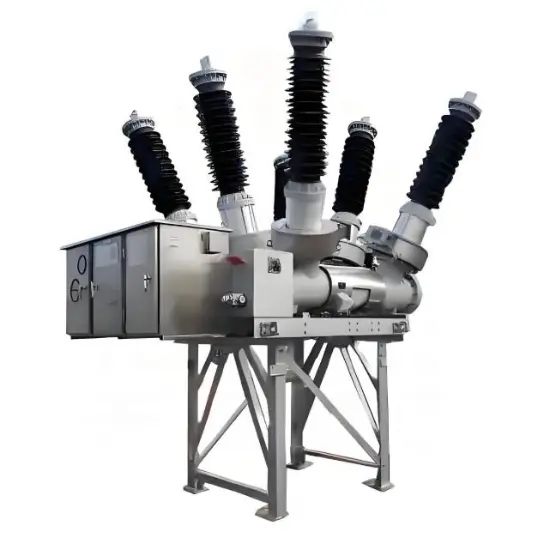
-
Outdoor Dead Tank SF6 Circuit Breaker direct supply 362kV
-
Dead Tank SF6 Circuit Breaker Original Manufacturer-115kV to 170kV
-
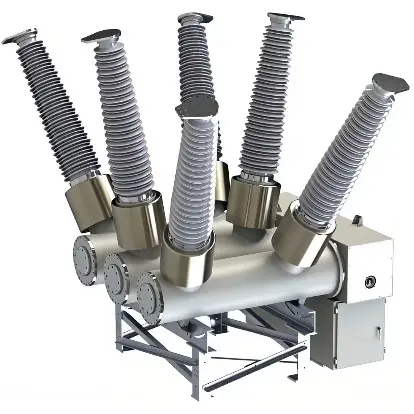
Dead Tank Vacuum Circuit Breaker(VCB)-36kV / 72.5kV
-
Maintenance-Free HV Dead-Tank SF6 Circuit Breaker for Large-Scale Substations-230kV to 252kV
-
Original Manufacturer Dead-Tank SF6 Circuit Breaker-170kV
-
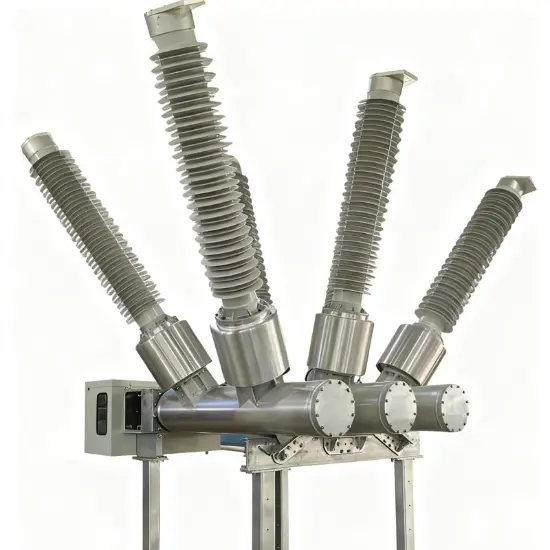
SF₆-free Dead Tank Circuit Breaker-72.5 kV
-
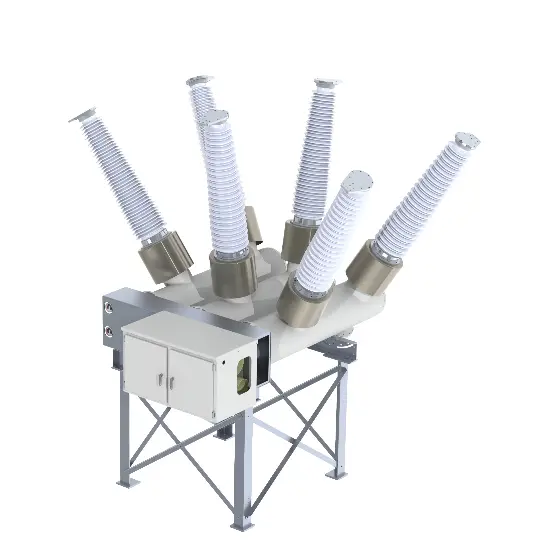
High reliability SF6-free Dead Tank Circuit Breaker-145 kV